Country reports are published here
They include those from:
- Joint programming missions;
- NCD, mental health and tobacco control investment cases;
- Primary health care costing reports; and
- Monitoring and evaluation activities.
Joint programming missions support UN Country Teams in their efforts to provide technical assistance to governments as they scale up comprehensive national NCD responses. These missions provide the opportunity for the UN System to engage with a range of government ministries and support them in adopting approaches to NCD policy development which involve all government departments. Joint programming missions also work with a range of development partners. These missions provide powerful advocate for ever stronger whole-of-government, whole-of-society, and whole-of-UN action.
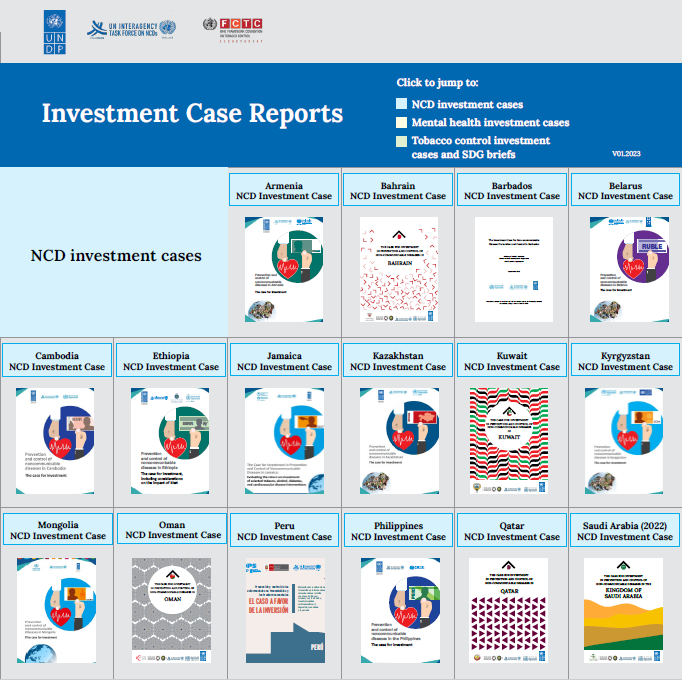
Investment cases quantify: (i) the socioeconomic burden of NCDs and their risk factors as well as mental health conditions in the country; (ii) the costs of evidence-based interventions to prevent and to treat NCDs and mental health conditions; and (iii) the return on investment of these interventions. Investment case reports can also be accessed through the interactive platform on this page. The tobacco investment cases have been undertaken as part of the 2030 project, led by the Framework Convention Secretariat, with UNDP as a collaborating partner.
Primary healthcare costing studies serve as a tool for policymakers, healthcare providers, and other stakeholders to promote primary healthcare as a an essential component of universal health coverage and the importance of preventing and controlling NCDs in primary care. They have been undertaken in six Gulf Cooperation Council countries (Bahrain, Kuwait, Oman, Qatar, Saudi Arabia, and the United Arab Emirates), where the studies have costed a package of eight primary healthcare programmes, including NCDs.
Bahrain
Bangladesh
Bosnia and Herzegovina
NCD Investment Cases:
Federation of Bosnia and Herzegovina - February 2024
Republika Srpska - February 2024
Cambodia
Ethiopia
Jamaica
Kenya
Madagascar
Malaysia
Mongolia
Montenegro
Oman
Suriname
Thailand
UN Joint Programming mission to Thailand: Supporting Thailand to tackle the epidemic of noncommunicable diseases
Mar 11, 2026, 10:14
by
User Not Found
UN Joint Programming mission to Thailand: Supporting Thailand to tackle the epidemic of noncommunicable diseases
The United Nations Inter-Agency Task Force on the Prevention and Control of NCDs (UNIATF) led by Dr Soumya Swaminathan, Deputy Director-General for Programmes, conducted a joint mission to Thailand, 27-30 August 2018.
The mission consisted of ten UN agencies: FAO, ITU, UNAIDS, UNDP, UNEP UNFPA, UNICEF, UNWomen, WFP and WHO and a large number of Thai experts. Meetings were held with the Prime Minister, ministers and senior officials across government as well as civil society organizations, selected private sector entities and academic institutions.
Noncommunicable diseases: Thailand country profile
NCDs are estimated to account for 74% of all deaths in Thailand and the probability of premature death from cardiovascular disease, cancer, diabetes and chronic respiratory disease in Thailand is 14%. NCDs are exerting a serious toll on the economy. Approximately 40% of men smoke. Current per capita consumption of alcohol is 8 litres - the highest in WHO’s South-East Asia Region. Levels of sodium intake are over twice the WHO recommended levels. A quarter of adults have raised blood pressure. Rates of obesity have increased dramatically in the past two decades.
Thailand is determined to get its NCDs under control and the following are exciting examples of how it is responding to the epidemic:
- Taxation on cigarettes is in line with WHO recommended levels: tobacco use has decreased from 32% in early 1990s to under 20% in the most recent survey in 2017 and the new tobacco product control act is in line with WHO FCTC.
- The Alcohol Beverage Control Act of 2008 and subsequent amendments place a ban on direct advertising and promotions, a minimum legal age of 18 years for drinking, new warning labels, and restriction on hours of sale.
- The government has announced a ban on Trans Fat in domestic and imported food products— from 9 January 2019 Thailand will be Trans Fat free.
- Government is working with industry and communities to reduce the amount of salt that people are consuming.
- A tax on sugar sweetened beverages (SSBs) has been recently introduced in an attempt to reduce consumption of unhealthy drinks.
- The Thai cabinet has taken on the role of national champion for improving levels of physical activity across the country in order to increase public awareness on the benefit of active lifestyles.
- Treating NCDs is a core element of the primary care system and the country has a strong commitment to universal health coverage. But without stepping up efforts on preventing NCDs, the costs of treatment will threaten the sustainability of UHC.
Findings and recommendations
Thailand has remarkable political will and commitment to tackle its burden of NCDs and outstanding leadership was observed at multiple levels: the Prime Minister, Minister of Public Health, the Ministry of Public Health, the Thai Health Promotion Foundation.
The Joint Mission recommended action in four areas that are in line with the set of evidence-based “best buys” and cost effective interventions that were endorsed by the World Health Assembly in 2017. These are being finalized in a report for the Government of Thailand.
The United Nations system in country also committed itself to provide ever greater support to the Government in responding to the NCD-related SDGs.
United Arab Emirates