Country reports are published here
They include those from:
- Joint programming missions;
- NCD, mental health and tobacco control investment cases;
- Primary health care costing reports; and
- Monitoring and evaluation activities.
Joint programming missions support UN Country Teams in their efforts to provide technical assistance to governments as they scale up comprehensive national NCD responses. These missions provide the opportunity for the UN System to engage with a range of government ministries and support them in adopting approaches to NCD policy development which involve all government departments. Joint programming missions also work with a range of development partners. These missions provide powerful advocate for ever stronger whole-of-government, whole-of-society, and whole-of-UN action.
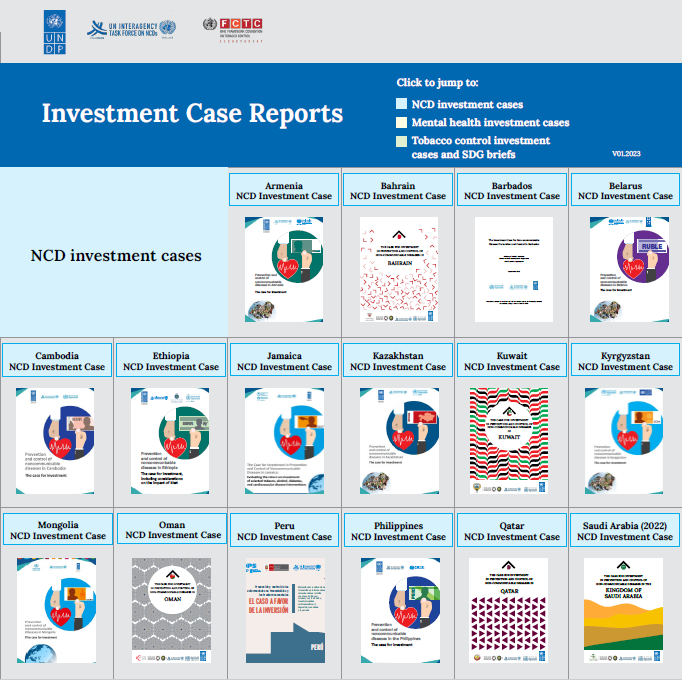
Investment cases quantify: (i) the socioeconomic burden of NCDs and their risk factors as well as mental health conditions in the country; (ii) the costs of evidence-based interventions to prevent and to treat NCDs and mental health conditions; and (iii) the return on investment of these interventions. Investment case reports can also be accessed through the interactive platform on this page. The tobacco investment cases have been undertaken as part of the 2030 project, led by the Framework Convention Secretariat, with UNDP as a collaborating partner.
Primary healthcare costing studies serve as a tool for policymakers, healthcare providers, and other stakeholders to promote primary healthcare as a an essential component of universal health coverage and the importance of preventing and controlling NCDs in primary care. They have been undertaken in six Gulf Cooperation Council countries (Bahrain, Kuwait, Oman, Qatar, Saudi Arabia, and the United Arab Emirates), where the studies have costed a package of eight primary healthcare programmes, including NCDs.
Bahrain
Bangladesh
Bosnia and Herzegovina
NCD Investment Cases:
Federation of Bosnia and Herzegovina - February 2024
Republika Srpska - February 2024
Cambodia
Ethiopia
Jamaica
Kenya
UN Task Force: Kenya’s fight against noncommunicable diseases aims to improve health, strengthen development
Mar 12, 2026, 07:38
by
User Not Found
UN Task Force: Kenya’s fight against noncommunicable diseases aims to improve health, strengthen development
Kenya is taking great strides to battle the epidemic of heart diseases and strokes, cancers, diabetes, and respiratory diseases, forging ahead with a whole-of-government response to preventing and controlling these conditions, to protect health and promote national development, a United Nations task force found at the end of weeklong mission to the country.
The conditions, known as noncommunicable diseases (NCDs), account for 27% of deaths suffered by Kenyans, equivalent to almost 100,000 people per year. The aim is to reduce the vast number of premature deaths for NCDs in Kenya in line with WHO voluntary global target of a 25% reduction in premature mortality from NCDs by 2025.
The mission to Kenya, which ended on 3 October, was a first to Africa by the United Nations Interagency Task Force for the Prevention and Control of NCDs. The visit of the Task Force comprised representatives from WHO, UNAIDS, UNDP, UNFPA, UNICEF and the World Bank and supported the Kenyan government and the UN Country Team to build and share solutions for the response to NCDs.
Kenya’s Cabinet Secretary for Health, Hon. James Macharia, praised the work of the UN mission, saying it underscored the needs and opportunities for multisectoral action to respond to NCDs. “NCDs is not just about Kenya, it is across the region, it is an issue for Africa,” Mr Macharia told the UN taskforce during a meeting Thursday. “This issue is being taken seriously by the highest levels of government, by the President.”
While posing clear health concerns, NCDs are also responsible for reducing productivity, curtailing economic growth and trapping the poorest people in chronic poverty in Kenya. The probability of dying too young from an NCD in Kenya is 18%. The main risk factors for NCDs in Kenya are exposure to tobacco use, physical inactivity, unhealthy diets and harmful use of alcohol due to effects of globalization on marketing and trade, rapid urbanization and population ageing. NCDs contribute to over 50% of inpatient admissions and 40% of hospital deaths, which dominates health care budgets in Kenya.
“The NCD policy framework in Kenya is robust and there is strong leadership from the Ministry of Health,” according to Dr Custodia Mandlhate, WHO’s Representative to Kenya. “Now is the time to secure ownership for multisectoral action right across government, the UN system and other stakeholders for the control and prevention of NCDs.”
The great levels of illness and death associated with NCDs has meant that the Kenyan government has prioritized NCDs prevention and control in its National Medium Term Plan (MTPII) 2014-2018; National Health Strategic Plan (KNSSP) 2014-2018; the just-launched United Nations Development Assisted Framework (UNDAF) 2014-2018 for Kenya; and the Kenya third generation WHO Country Cooperation Strategy (2014-2019). A specific strategy for tacking NCDs is expected to be finalized shortly.
Findings from the UN mission included:
- Total tobacco smoking is estimated at 26% among Kenyan men. Worryingly, among those aged 13-15 years, 15% currently consume some form of tobacco product, and more than a quarter of youth (25%) are exposed to second hand tobacco smoke at home.
- Prevalence of insufficient physical activity for adults aged 18 and over is estimated to be 10% in men and 14% in women in 2010.
- 18% percent of Kenyan pre-school children are obese.
- Around 30% of Kenyan adults are overweight and around 9% are obese.
- The total estimated consumption of pure alcohol in Kenya is 4.3 litres per adult aged 15+ per year, much higher than the African average, with significant reporting of heavy episodic drinking.
- Health expenditure is less than 5% of GDP, significant less than the 15% goal set out in the Abuja Declaration of 1989.
All Kenyan ministries acknowledged NCDs as an increasing concern for the country and that further rapid urbanization and globalization of marketing and trade will only worsen the situation.
“The social, economic and physical environments in developing countries like Kenya afford their populations much lower levels of protection from the risks and consequences of NCDs than in developed countries,” according to Dudley Tarlton, Programme Specialist for Health and Development at UNDP. “In developed countries, the population often benefits from Governments’ policies and plans to reduce the exposure to risk factors for NCDs, while strengthening the capacity of individuals and populations to make healthier choices and follow lifestyle patterns that follow good health Insufficient action will result in significant socioeconomic drag for Kenya, which is just emerging as a low middle-income country and an additional burden for the health system that it can ill afford.”
The UN mission issued a range of recommendations to Kenyan authorities to drive policy making to stem the impact of NCDs, including:
- Focusing on premature death, which has the greatest socioeconomic impact.
- Having a firm focus on the most cost-effective interventions available for NCDs.
- Raising awareness on NCDs at the highest levels on government.
- Ensuring that all parts of government and society respond to the challenges of NCDs as health gains can be achieved much more readily by influencing public policies in sectors beyond health than by making changes in health policy alone.
- Identifying opportunities for linking the promotion of NCD prevention and control into existing programmes in both the health sector and other sectors such as education, labour and urban development.
- Placing a stronger emphasis on protecting people from the exposure to highly processed foods and beverages loaded with fats, salt and sugar and raising awareness among the population.
The UN Task Force was established by the UN Secretary-General in June 2013 and placed under WHO’s leadership. It is coordinating the activities of the relevant UN organizations and other intergovernmental bodies to help realize the Heads of State commitments in the 2011 UN Political Declaration on NCDs, in particular by implementing the WHO Global Action Plan for the Prevention and Control of Noncommunicable Diseases 2013–2020 and the 2014 UN Outcome Document on NCDs.
Globally, over 14 million people die each year from NCDs between the ages of 30 and 70, of which 85% are in developing countries. The probability of dying from any of the major NCDs between the ages of 30 and 70 ranges from 10% in developed countries to 60% in low- and middle-income countries. It is estimated that up to two-thirds of premature deaths are linked to exposure to risk factors (namely, tobacco use, unhealthy diet and physical inactivity, and the harmful use of alcohol) and up to half of all such deaths are linked to weak health systems that do not respond effectively and equitably to the health-care needs of people with NCDs.
Madagascar
Malaysia
Mongolia
Montenegro
Oman
Suriname
Thailand
United Arab Emirates