Country reports are published here
They include those from:
- Joint programming missions;
- NCD, mental health and tobacco control investment cases;
- Primary health care costing reports; and
- Monitoring and evaluation activities.
Joint programming missions support UN Country Teams in their efforts to provide technical assistance to governments as they scale up comprehensive national NCD responses. These missions provide the opportunity for the UN System to engage with a range of government ministries and support them in adopting approaches to NCD policy development which involve all government departments. Joint programming missions also work with a range of development partners. These missions provide powerful advocate for ever stronger whole-of-government, whole-of-society, and whole-of-UN action.
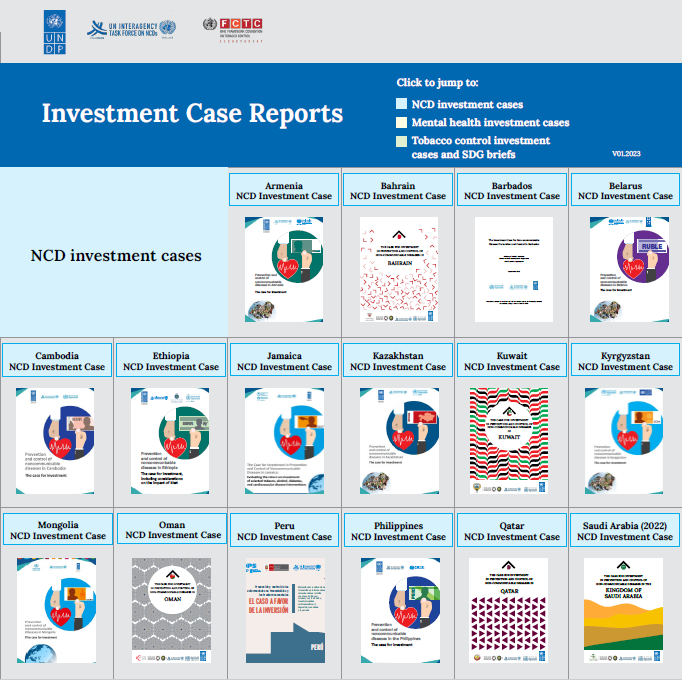
Investment cases quantify: (i) the socioeconomic burden of NCDs and their risk factors as well as mental health conditions in the country; (ii) the costs of evidence-based interventions to prevent and to treat NCDs and mental health conditions; and (iii) the return on investment of these interventions. Investment case reports can also be accessed through the interactive platform on this page. The tobacco investment cases have been undertaken as part of the 2030 project, led by the Framework Convention Secretariat, with UNDP as a collaborating partner.
Primary healthcare costing studies serve as a tool for policymakers, healthcare providers, and other stakeholders to promote primary healthcare as a an essential component of universal health coverage and the importance of preventing and controlling NCDs in primary care. They have been undertaken in six Gulf Cooperation Council countries (Bahrain, Kuwait, Oman, Qatar, Saudi Arabia, and the United Arab Emirates), where the studies have costed a package of eight primary healthcare programmes, including NCDs.
Algeria
Task Force evaluation of Algeria Multisectoral Action Plan charts way forward for an updated plan
Mar 10, 2026, 07:17
by
User Not Found
The Government of Algeria warmly welcomed the recently published evaluation report of Algeria’s Multisectoral Action Plan for Non-communicable Diseases (NCDs). In particular, the Ministry of Health endorsed the report’s recommendations for a new plan, the drafting of which is underway.
The evaluation identified a number of areas that would make the next plan even more effective. First is focusing on a smaller number of costed actions with clearly defined targets. Second is increasing the capacity and accountability of a set of key partners across government but also beyond. And third is strengthening Prime Ministerial oversight of NCDs.
At the request of the Government of Algeria, the Task Force Secretariat led the evaluation with two of its members, the World Health Organization and the United Nations Development Programme.
The evaluation was clear that Algeria’s Strategic Plan, which recently concluded, had resulted in action across government and its partners, and demonstrated a number of tangible results.
Scott Chiossi from the Task Force Secretariat said, ‘These evaluations are crucial in building ever stronger action to prevent and control NCDs. The Task Force stands by to provide support to Algeria in developing its new strategy and plan of action’.
The report is available in French on the WHO Algeria Country Office website. French and English versions are also available on the NCD Task Force website.
Bahrain
Bangladesh
Bosnia and Herzegovina
NCD Investment Cases:
Federation of Bosnia and Herzegovina - February 2024
Republika Srpska - February 2024
Cambodia
Ethiopia
Jamaica
Kenya
Madagascar
Malaysia
Mongolia
Montenegro
Oman
Suriname
Thailand
United Arab Emirates