Country reports are published here
They include those from:
- Joint programming missions;
- NCD, mental health and tobacco control investment cases;
- Primary health care costing reports; and
- Monitoring and evaluation activities.
Joint programming missions support UN Country Teams in their efforts to provide technical assistance to governments as they scale up comprehensive national NCD responses. These missions provide the opportunity for the UN System to engage with a range of government ministries and support them in adopting approaches to NCD policy development which involve all government departments. Joint programming missions also work with a range of development partners. These missions provide powerful advocate for ever stronger whole-of-government, whole-of-society, and whole-of-UN action.
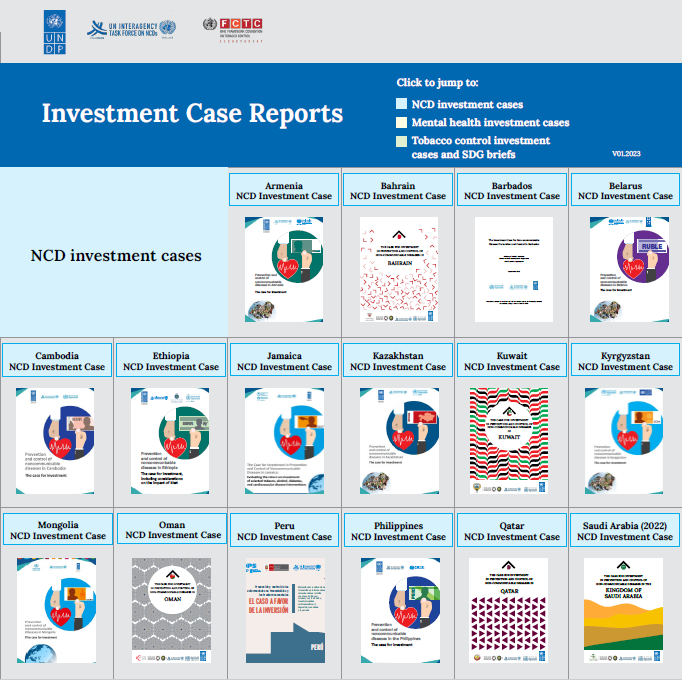
Investment cases quantify: (i) the socioeconomic burden of NCDs and their risk factors as well as mental health conditions in the country; (ii) the costs of evidence-based interventions to prevent and to treat NCDs and mental health conditions; and (iii) the return on investment of these interventions. Investment case reports can also be accessed through the interactive platform on this page. The tobacco investment cases have been undertaken as part of the 2030 project, led by the Framework Convention Secretariat, with UNDP as a collaborating partner.
Primary healthcare costing studies serve as a tool for policymakers, healthcare providers, and other stakeholders to promote primary healthcare as a an essential component of universal health coverage and the importance of preventing and controlling NCDs in primary care. They have been undertaken in six Gulf Cooperation Council countries (Bahrain, Kuwait, Oman, Qatar, Saudi Arabia, and the United Arab Emirates), where the studies have costed a package of eight primary healthcare programmes, including NCDs.
Bahrain
Bangladesh
Bosnia and Herzegovina
NCD Investment Cases:
Federation of Bosnia and Herzegovina - February 2024
Republika Srpska - February 2024
Cambodia
Ethiopia
Jamaica
Kenya
Madagascar
Malaysia
Mongolia
Launch of NCD investment case in Mongolia
Mar 12, 2026, 07:28
by
User Not Found
Launch of NCD Investment Case in Mongolia
Scaling up heart disease and tobacco control and reducing consumption of alcohol and salt are areas requiring increased investment in Mongolia to address noncommunicable diseases (NCDs), according to results from a review led by the United Nations Interagency Task Force (UNIATF) on NCDs.
The review, part of the UNIATF’s work to help countries develop accelerated action to prevent and control cardiovascular and chronic respiratory diseases, cancers and diabetes, was presented to a multistakeholder forum in Ulaanbaatar, Mongolia, on 12 December 2017.
Mongolia’s Minister of Health, Mrs Sarangerel, says the results of the UNIATF’s review are “very important” and would guide her country’s actions to further address NCDs.
“The results of the UNIATF’s work highlight the significant economic impact of investing in the prevention of NCD,” Mrs Sarangerel says. “The report demonstrates the huge return on investment from implementing and enforcing salt reduction policies as well as those to reduce tobacco use and harmful use of alcohol. I will be sharing these results with the Prime Minister and Cabinet colleagues in order for us to scale up action across government to reduce the high levels of ill-health and premature mortality from cardiovascular disease and NCDs more broadly.”
NCDs: a major issue for Mongolia
NCDs are a major cause of premature mortality and ill health in Mongolia. These diseases are responsible for almost 80% of all deaths in the country. Most worryingly, there is a 30% probability of dying prematurely (i.e. between age of 30 and 70 years) from NCDs in Mongolia.
In 2015, the UNIATF undertook a joint programming mission to Mongolia. A key recommendation was to develop the case of investing in the prevention and control of NCDs in the country.
The investment case
WHO, UNDP and the Research Triangle Institute International from the United States presented the investment case, which assessed the cost of scaling up action in four areas: tobacco control, reduction in harmful use of alcohol, reduction in salt consumption and more effective treatment of cardiovascular diseases. In each of these areas the impact of implementing a package of policy measures was assessed and the return on investment calculated.
The interventions included in the investment case were as follows:
- Scaling up the management of cardiovascular disease through screening, treatment for individuals with high cholesterol levels, treatment for individuals with hypertension and those at high risk of a cardiovascular event such as a heart attack or stroke;
- Scaling up tobacco control through bans on indirect tobacco advertising, raising taxes and implementing plain packaging of tobacco products;
- Tackling harmful use of alcohol by restricting the availability of retailed alcohol, restricting alcohol advertising and raising taxes;
- Reducing salt consumption in the population by harnessing industry to reformulate food products, implementing front-of-package labeling, education and communication programmes and putting in place community-based salt reduction strategies.
The results showed that implementing a small set of policy and clinical interventions would lead to significant health and economic benefits. Taken together, they would result in over 2.4 trillion MNT (US$ 990 million) in productivity gains over 15 years, a direct result of a decrease in Mongolians: (1) dropping out of the workforce due to premature mortality, (2) missing days of work, and (3) working at a reduced capacity due to poor health. This gain is equivalent to around 1 percent of Mongolia’s GDP each year when averaged out over the next 15 years.
Salt reduction is the “best-buy”
The Forum heard that all four intervention packages lead to return on investment, but salt reduction topped the list: over 15 years, the return on investment in salt reduction measures would be almost 17-fold. Currently, the salt consumption in Mongolian population is estimated to be more than double of the WHO recommended daily salt intake. High salt intake increases blood pressure, which can lead to heart disease. Salt interventions, such as reformulation of food products, food labelling or awareness raising, act to reduce blood pressure in the population, and thus lead to reduction in cardiovascular diseases.
Scaling up national efforts on the prevention and control of NCD
The Forum discussed the implications of the findings. Mongolia has one of the highest premature mortality rates due to NCDs among low and middle-income countries. What is now required is even greater political commitment to address NCDs through a multisectoral approach, as almost all the interventions reviewed in the study require action across the public sector in collaboration with the industry and other development partners.
WHO Representative a.i. to Mongolia, Dr Sergey Diorditsa, praised the UNIATF’s efforts to shed light on the challenges and opportunities that exist for NCD control in the country.
“The investment case demonstrates the importance of both preventing and managing NCDs ever more effectively,” says Dr Diorditsa. “It really shows the health and economic impact of implementing a small number of highly effective, feasible and cost-effective interventions. We now need to work tirelessly to ensure these are taken up in Mongolia”
Putting the right laws and policies in place is important, but it is crucial to ensure they are enforced. The forum agreed that it is critical that sectors beyond health are involved in the national NCD response if Mongolia is to achieve the NCD-related SDG targets. Critical too, is the engagement of civil society organizations and the private sector.
Mrs. Beate Trankmann, UN Resident Coordinator in Mongolia concluded: "Fighting NCDs is a priority in Mongolia's Sustainable Development Vision 2030 and is a key area of UN support in our Development Assistance Framework 2017-2021. As the UN, we are committed to scale up our support and would like to invite development partners to join forces".
Guidance is on hand to help Mongolia move forward
The Forum then reviewed technical tools that WHO has produced to help countries prevent and control NCDs and to meet obligations under the WHO Framework for Tobacco Control. These include, MPOWER for tobacco control, SHAKE for salt reduction, HEARTS for the management of cardiovascular disease, and Global strategy to reduce harmful use of alcohol.
The forum was attended by ministers and senior officials from Government as well as health leaders from across the Mongolian healthcare system. Development partners including UN agencies, embassies, civil society and academia also joined as well as representatives from the private sector.
Montenegro
Oman
Suriname
Thailand
United Arab Emirates