Country reports are published here
They include those from:
- Joint programming missions;
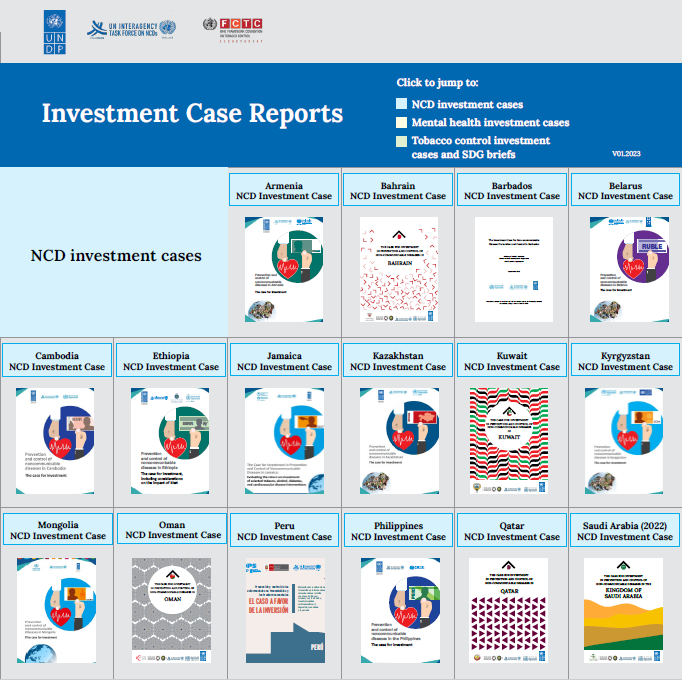
- NCD, mental health and tobacco control investment cases;
- Primary health care costing reports; and
- Monitoring and evaluation activities.
Joint programming missions support UN Country Teams in their efforts to provide technical assistance to governments as they scale up comprehensive national NCD responses. These missions provide the opportunity for the UN System to engage with a range of government ministries and support them in adopting approaches to NCD policy development which involve all government departments. Joint programming missions also work with a range of development partners. These missions provide powerful advocate for ever stronger whole-of-government, whole-of-society, and whole-of-UN action.
Investment cases quantify: (i) the socioeconomic burden of NCDs and their risk factors as well as mental health conditions in the country; (ii) the costs of evidence-based interventions to prevent and to treat NCDs and mental health conditions; and (iii) the return on investment of these interventions. Investment case reports can also be accessed through the interactive platform on this page. The tobacco investment cases have been undertaken as part of the 2030 project, led by the Framework Convention Secretariat, with UNDP as a collaborating partner.
Primary healthcare costing studies serve as a tool for policymakers, healthcare providers, and other stakeholders to promote primary healthcare as a an essential component of universal health coverage and the importance of preventing and controlling NCDs in primary care. They have been undertaken in six Gulf Cooperation Council countries (Bahrain, Kuwait, Oman, Qatar, Saudi Arabia, and the United Arab Emirates), where the studies have costed a package of eight primary healthcare programmes, including NCDs.
Bahrain
Bangladesh
Bosnia and Herzegovina
NCD Investment Cases:
Federation of Bosnia and Herzegovina - February 2024
Republika Srpska - February 2024
Cambodia
Ethiopia
Jamaica
Kenya
Madagascar
Malaysia
Mongolia
Montenegro
Oman
Suriname
Thailand
Turkey
UN Interagency Task Force on NCDs supports Turkey drive forward action on noncommunicable diseases
Mar 11, 2026, 10:03
by
User Not Found
UN Interagency Task Force on NCDs supports Turkey drive forward action on noncommunicable diseases
The United Nations Interagency Task Force on the Prevention and Control of Noncommunicable Diseases (NCDs) carried out a mission to Turkey from 20 to 22 April 2016 to support the Government of Turkey to reflect the NCD-related SDG targets included in the 2030 Agenda for Sustainable Development in national development plans and policies, and accelerate the implementation of national commitments included in the 2011 United Nations General Assembly Political Declaration on NCDs and the 2014 UN General Assembly Outcome Document on NCDs.
Cardiovascular diseases stand for 47% of all deaths in Turkey
NCDs - principally cardiovascular diseases, diabetes, cancers, chronic respiratory diseases cause 86% of all deaths in Turkey. Most worryingly, the probability of dying prematurely (i.e. before the age of 70 years) from NCDs in Turkey is 18%, which means that nearly one of every five adult dies before they should.
“I invited the UN Task Force to Turkey because I want to ensure that we have a whole-of-government and whole-of-society response to NCDs. The epidemic of NCDs is now one of our biggest socioeconomic issues”, said Dr Mehmet Müezzinoglu, Minister of Health of Turkey. “We simply cannot afford the costs of people becoming ill from NCDs at such a young age” he added.
Dr Pavel Ursu, WHO Representative in Turkey said, “We are committed to support the Government putting NCDs at the forefront of the national development agenda and to see government working together to tackle some of the key causes of NCDs such as smoking, where nearly one in three men smoke and levels of salt intake that are 3 times higher than WHO recommends.”. “Every second death in Turkey is from cardiovascular disease and 80% of these premature deaths can be prevented”, Dr Ursu emphasized.
“Tackling NCDs is crucial for sustainable development and for ensuring that Turkey reaches its full socioeconomic potential” said Mr Kamal Malhotra, UN Resident Coordinator and UNDP Resident Representative in Turkey. “I am committed to ensuring that the UN Country Team here in Turkey supports the Government in its multisectoral response to NCDs”, he highlighted.
Government involvement is crucial to tackle noncommunicable diseases effectively
“A multisectoral action requires whole-of-government and whole-of society-approaches”, said Dr Gauden Galea, Director of the Division of NCDs and Life-course at WHO’s European Office. “If Turkey is going to tackle tobacco use, and a diet that is high in salt, sugar and saturated fat, as well as physical inactivity then government ministries must come together and engage to ensure policy coherence and mutual accountability of different spheres of policy making that have a bearing on NCDs”, he added.
“We were pleased to hear the plans of the Government to finalize a national multisectoral NCD action plan. We urge this to be completed as soon as possible and for the plan to include a set of national targets”, said Mr John Macauley, from the United Nations Development Programme’s Istanbul’s Regional Office for Eastern Europe and Central Asia.
The mission will be making a series of recommendations that encourage action to tackle NCDs in Turkey alongside a commitment for the UN system to scale up its technical assistance to the Government and make its policy expertise available at all stages of implementation. The Government’s commitment to engage with all sectors of society, including civil society is crucial.
Focus on primary care
The mission also heard that there has been significant progress in scaling up action for NCDs in primary care, particularly in the detection and management of cardiovascular disease and diabetes. The mission welcomed Turkey’s efforts to increase the number of staff working in primary care. The mission was also impressed with the recent increase in coverage of cervical cancer screening. “We are committed to provide high quality health services to those with NCDs, with a focus on primary care”, added Dr Mehmet Muezzinoglu, Minister of Health.
The mission included representatives from the following six agencies: Food and Agriculture Organization (FAO), International Labour Office (ILO), United Nations Development Programme (UNDP), United Nations Population Fund (UNFPA), United Nations Children's Fund (UNICEF) and the World Health Organization (WHO), which led the mission.
The Mission met with ministries of health, economy, development, family and social policies, education, and youth and sport and President of Health, Family, Labor and Social Affairs Commission of the Grand National Assembly of Turkey. The Mission also met with representatives of civil society, including NGOs and professional and academic associations.
“The mission is optimistic that Turkey can rise to the challenge on NCDs”, said Dr Nick Banatvala from WHO Geneva. The recently 2015 WHO NCD Progress Monitor1, scored countries against 18 specific targets on national NCD planning, surveillance, as well as policies in place for the prevention and management of NCD. According to the report, Turkey had fully met a number of these 18 targets. “The joint mission believes that by 2018, when Turkey along with other countries has to report on progress to the UN General Assembly, more of these targets can be fully achieved,” Dr Nick Banatvala concluded.
For Mission findings regarding NCDs in Turkey see table to the right.
Reference
1 2 NCD Progress Monitor 2015 (page 107). WHO.
United Arab Emirates