Country reports are published here
They include those from:
- Joint programming missions;
- NCD, mental health and tobacco control investment cases;
- Primary health care costing reports; and
- Monitoring and evaluation activities.
Joint programming missions support UN Country Teams in their efforts to provide technical assistance to governments as they scale up comprehensive national NCD responses. These missions provide the opportunity for the UN System to engage with a range of government ministries and support them in adopting approaches to NCD policy development which involve all government departments. Joint programming missions also work with a range of development partners. These missions provide powerful advocate for ever stronger whole-of-government, whole-of-society, and whole-of-UN action.
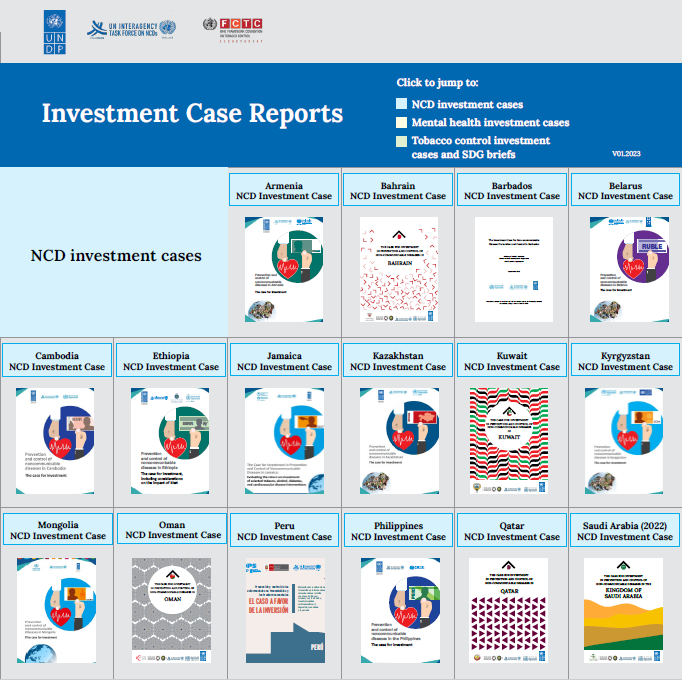
Investment cases quantify: (i) the socioeconomic burden of NCDs and their risk factors as well as mental health conditions in the country; (ii) the costs of evidence-based interventions to prevent and to treat NCDs and mental health conditions; and (iii) the return on investment of these interventions. Investment case reports can also be accessed through the interactive platform on this page. The tobacco investment cases have been undertaken as part of the 2030 project, led by the Framework Convention Secretariat, with UNDP as a collaborating partner.
Primary healthcare costing studies serve as a tool for policymakers, healthcare providers, and other stakeholders to promote primary healthcare as a an essential component of universal health coverage and the importance of preventing and controlling NCDs in primary care. They have been undertaken in six Gulf Cooperation Council countries (Bahrain, Kuwait, Oman, Qatar, Saudi Arabia, and the United Arab Emirates), where the studies have costed a package of eight primary healthcare programmes, including NCDs.
Bahrain
Bangladesh
Bosnia and Herzegovina
NCD Investment Cases:
Federation of Bosnia and Herzegovina - February 2024
Republika Srpska - February 2024
Cambodia
Ethiopia
Jamaica
Kenya
Madagascar
Malaysia
Mongolia
Montenegro
Oman
Russia
Advancing Russia's response to noncommunicable diseases through an investment case
Mar 11, 2026, 10:16
by
User Not Found
Addressing cancers, diabetes, heart disease and other noncommunicable diseases (NCDs) in Cambodia is crucial to ensure health and well-being for all, maintain rapid economic growth, and achieve the Sustainable Development Goals.
WHO and its Regional Office for Europe, together with the United Nations Development Programme (UNDP), conducted an initial data collection mission in the Russian Federation to develop an investment case on noncommunicable diseases (NCDs). The study will seek to quantify the social and economic costs of NCDs for the country’s economy and to identify the most cost-effective interventions at the national level.
According to the latest data, NCDs cause more than 1.6 million deaths in Russia each year. Thirty-seven percent of adults in Russia use tobacco and over 18 percent are physically inactive. Daily salt intake, estimated at 11 grams per day, exceeds the WHO recommended levels more than twice, and the average alcohol intake among adults is higher than average for Europe, with 12 liters of pure alcohol per capita consumption per year.
The prevention and control of NCDs is prioritized in the national project “Demography”, as well as in the strategic goals under the Presidential Decree No. 204 of 2018, aiming to reduce premature mortality from major NCDs, with a priority on cardiovascular diseases and cancer.
There are sound examples where Russian Federation is leading the way. In recent years, Russia has made important changes in its tobacco control policy, banning smoking in public places, and prohibiting advertising, promotion and sponsorship of tobacco products. As a result, the prevalence of smoking is estimated to have decreased by an impressive 21 percent in the past seven years, while the prevalence of exposure to second-hand smoke decreased by 27 percent. Measures have also been taken to promote physical activity, leading to an 18 percent increase in the past four years in the number of people practicing sports.
To build on the above successes, experts from the Ministry of Health and from the UN Interagency Task Force on the Prevention and Control of NCDs held meetings in Moscow this week to agree on the study objectives and methodology, and to define a blueprint for joint work on data collection, economic analysis and finalization of the NCD investment case report.
Further work will focus on analyzing the economic and social implications of NCD policies and identifying the most cost-effective interventions based on the WHO “Best Buys”, which if implemented significantly reduce NCD-related mortality and morbidity. Preliminary estimates suggest that implementing these interventions could save more than half a million lives in Russia by 2025.
A special component on mental health will be included in the next phase of the analysis.
Once finalized, the findings of the Investment Case report for Russia will be presented to the Government to encourage a whole-of government and whole-of-society response to NCDs. The UN and national partners agreed to present the results of the case at the Third All-Russian Forum on Public Health in October 2019 in Moscow.
Suriname
Thailand
United Arab Emirates